Enhanced TRaCE Model Implementation Guide
Background and Origin of the TRaCE Model

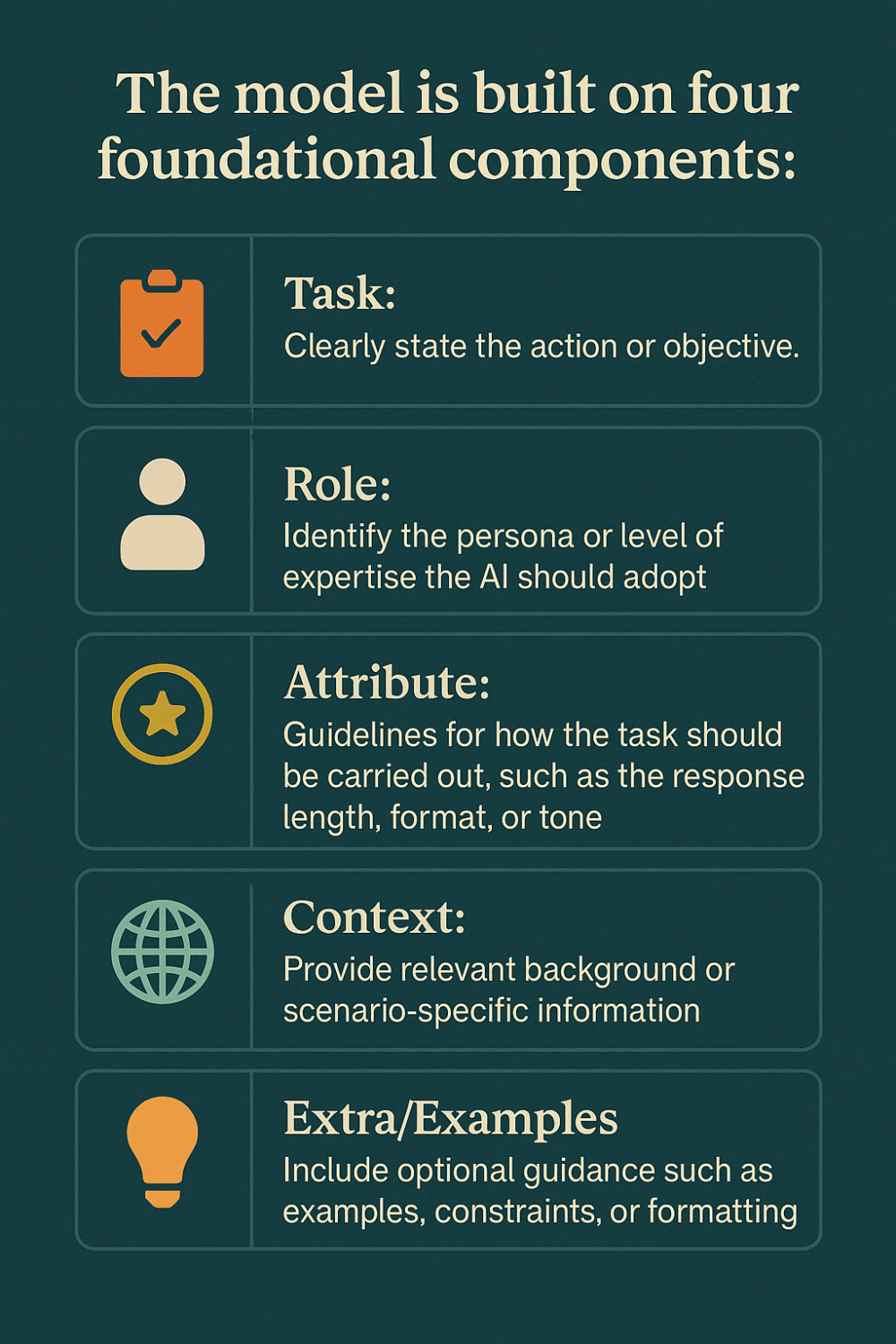
The TRaCE Model was originally developed as a structured framework to enhance prompt engineering, ensuring users receive more accurate and high-quality AI responses. The model is built on four foundational components:
Task: Clearly state the action or objective.
Role: Identify the persona or level of expertise the AI should adopt.
Attribute: Guidelines for how the task should be carried out, such as the response length, format, or tone.
Context: Provide relevant background or scenario-specific information.
Extra/Examples: Include optional guidance such as examples, constraints, or formatting.
This model was influenced by instructional design principles and the need for clear, adaptable prompt templates across educational and professional environments. As AI capabilities evolved and user expectations grew, the model required expansion to incorporate ethical awareness, feedback loops, personalisation, and evidence-based reasoning.
The enhancements below aim to make the TRaCE model more responsive, educationally grounded, and suited to complex learning and communication needs.
1. Clarify Role Definition
Updated Structure:
Role: Define the required expertise level or tone for the task.
Expert Role: Subject matter expert providing in-depth explanations.
Student Role: Beginner-friendly tone with simplified language.
Assistant Role: Collaborative or casual helper tone.
Example Prompts:
"Imagine you are a subject matter expert on quantum physics. Explain the basics of quantum entanglement."
"Imagine you are an assistant helping a student understand the concept of photosynthesis in simple terms."
2. Refine Context Section with Scenario Building
Updated Structure:
Scenario-Based Context: Use role-play or imagined settings.
Example Prompt:
"Imagine you're presenting to a group of 8th-grade students about the causes of the French Revolution. Focus on the social and economic factors that led to it."
3. Incorporate Feedback Loops for Iterative Refinement
Updated Structure:
"Was this the level of detail you were looking for? If not, please specify what you’d like more or less of."
"Provide a summary of the impact of climate change on agriculture in Africa. Afterward, ask if the summary meets the user’s expectations."
4. Expand on Evidence-Based Responses
Updated Structure:
"Describe the water cycle and provide references to support your explanation."
"Explain why this information is relevant and cite your sources."
5. Promote Handling of Ambiguity and Uncertainty
Updated Structure:
"Can you clarify which aspect of the topic you'd like to explore?"
"Explain the causes of World War I. If this seems too broad, ask whether to focus on political, economic, or social causes."
6. Introduce Personalised Adaptation for Long-Form Responses
Updated Structure:
"Write in a formal, academic tone for a professional audience."
"Use a conversational style suitable for general readers."
"Produce a graduate-level essay on the evolution of AI, using formal language and citing recent research."
7. Include Ethical Considerations
Updated Structure:
"Discuss the cultural impact of AI in education. Ensure the discussion is free from bias."
"Make sure the explanation avoids stereotypes and uses inclusive language."
8. Refine the Extra/Examples Section for Flexibility
Updated Structure:
"List key factors contributing to global warming in bullet points, no longer than 150 words."
"Write your response in bullet points and limit it to 300 words."
Updated Structure:
"List key factors contributing to global warming in bullet points, no longer than 150 words."
"Write your response in bullet points and limit it to 300 words."
9. Attributes Section
Updated Structure:
Full Example of an Enhanced TRaCE Prompt
Scenario:
Keep the response clear and concise, within three paragraphs.
Include a step-by-step breakdown of the water cycle.
Ensure scientific accuracy while simplifying for a secondary school level.
Context:
Refinement: "Is this level of detail appropriate for your students? Let me know if you’d like to adjust the complexity."
Evidence-Based: "Support your explanation with at least one reputable source."
Ethical Guidelines: "Use culturally neutral language and avoid stereotypes, especially when discussing water cycles across global regions."
Handling Ambiguity: "If the scope seems too broad, ask the user whether to focus on ecosystems, oceans, or human activity."
Resultant
🌍 Water Cycle Explained for High School Students
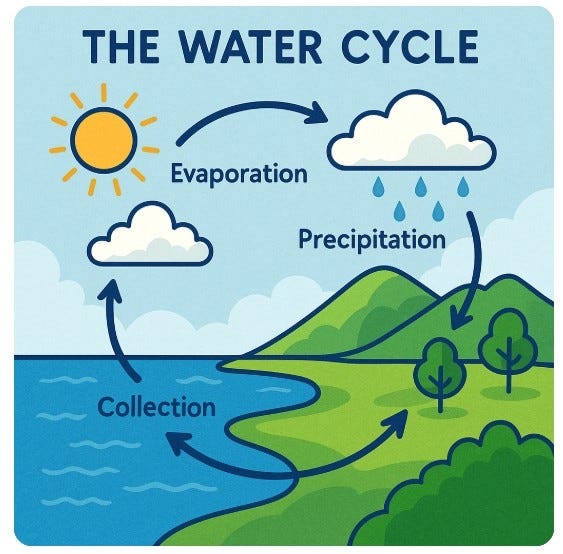
Evaporation: Heat from the Sun causes water from oceans, lakes, and rivers to change into water vapour, rising into the atmosphere.
Condensation: As the water vapour cools down in the upper atmosphere, it turns back into liquid droplets, forming clouds.
Precipitation: When the droplets in clouds become too heavy, they fall back to Earth as rain, snow, sleet, or hail.
Collection: This water gathers in bodies like rivers, lakes, and oceans, or infiltrates into the ground—ready to be evaporated again.
This continuous loop supports life, regulates climate, and shapes ecosystems across the globe. For further reading, the